
Rattled Chess Master: Peter Thiel

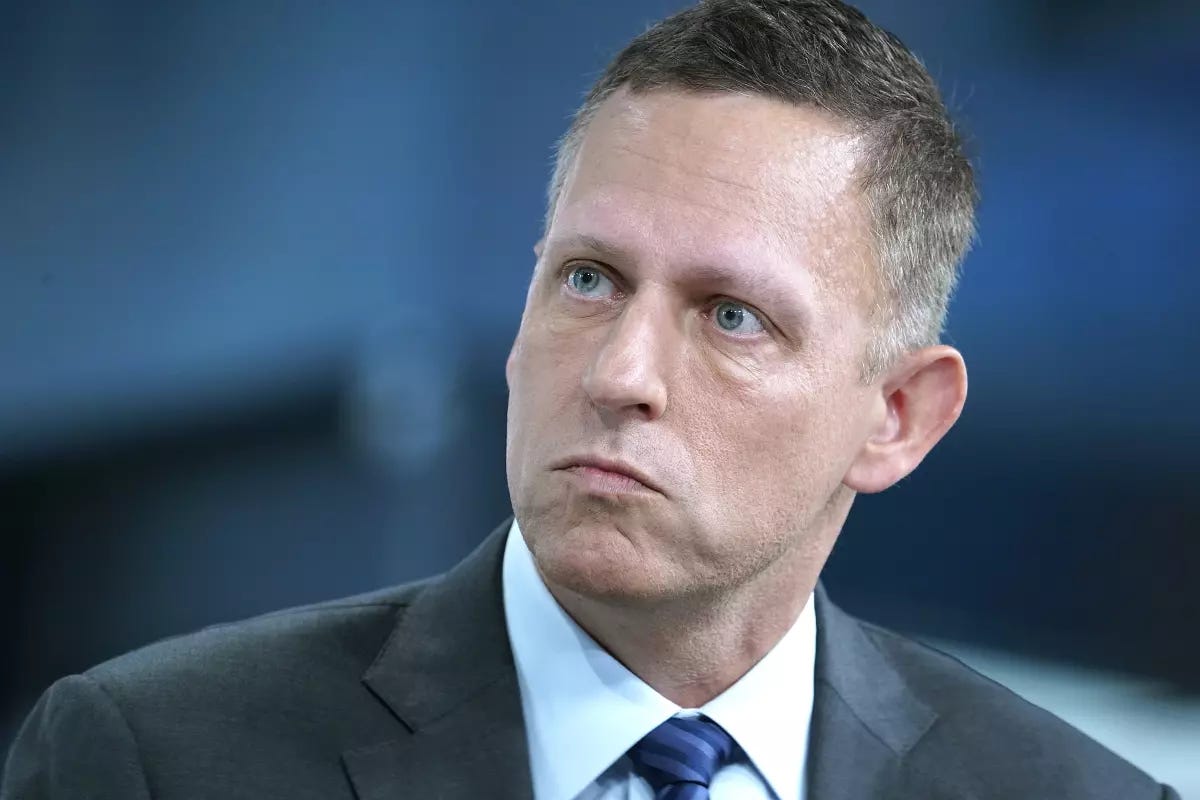
This guy, who looks like he just got called out for shitting his pants at a formal dinner, is billionaire Peter Thiel. Maybe you’ve heard of him. Maybe not.
Max Chafkin wrote a biography of him called The Contrarian a few years ago, which I read, and I’m also going to be drawing on the Behind the Bastards’ four-parter and assorted articles I’ve picked up on over the years.
Caveat on Peter here: despite the amount of information available about him, he’s frankly… kinda boring as shit to learn about. But also a very nasty wart of a figure. The banality of evil and all that, I guess.
Per my memory, around the time the book came out the major excerpt that made the rounds was about him speeding with pals in college, being pulled over, mouthing off to the cop about his libertarian philosophy and how speed limits shouldn’t exist, getting off with a warning, and speeding off, pedal-to-the-metal into the night again.
I have a story a bit like that, when Daniel wanted to go to Sonic one night with the group after his cancer came back. We got pulled over on the way back, but we didn’t get off due to arguing with the cop; I mostly remember being in the backseat, high as a kite, thinking about how much of a buzzkill it’d be if we ended up in jail cause the driver wouldn’t go the limit. And how are we going to explain this, “We thought the best way to get his mind off cancer was to get in trouble with the cops”?
I find my story about as relevant to this post as I find Thiel’s to the book; I seem to remember coming across it getting a significant amount of buzz and it falls flat for me.
On the other hand, on Behind the Bastards, Evans highlights a much more telling story about him. Thiel is a big chess fan and, at a chess tournament, was apparently taking on some casual matches. He’d been doing alright in real play, but he wasn’t paying attention and lost during casual.
This rattled him. He could not accept this meaningless loss and it led to him crumbling when there was no need. His confidence was that easily shattered.
Peter Thiel explains his decision not to fund any presidential candidates in 2024
There are theories about why he sat out 2024 in contrast to, say, 2016 or 2020 as well as the ‘unique’ nature of his donations to election-deniers. One ex of his claims he talked Thiel out of 2024 due to the homophobia of the right. I think it’s just because he thought the election was a loser due to being rattled, like that chess match, and ideally he remains sitting out of the match for the time being.
But Thiel’s still worth learning about, in no small part because of his close ties to his “house philosopher,” that radical nutcase Curtis Yarvin. Yarvin, with his bullshit ‘dark enlightenment’ edge, has described Thiel as “fully enlightened, just plays it very carefully.”
As in: he completely does not believe in fundamental human rights.
Which is really unsurprising, all things considered, particularly his supervillain origin story youth growing up in Namibia. Namibia was being illegally occupied by white-supremacist governments (like those Afrikaners Trump just let in as “refugees”). Despite being ordered out, South Africa’s occupation of Namibia would continue due to Western nations willingness to purchase radioactive uranium.
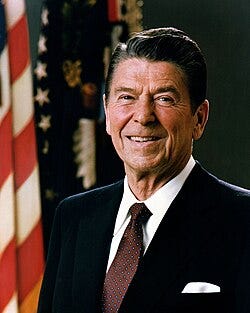
Yes, Reagan did love apartheid South Africa and ‘Southwest Africa,’ or Namibia, but that was a bit later.
Radioactive materials, of course, are dangerous to mine, which was why this labor was reserved for uninformed Africans. Whites, like Peter’s father, were kept protected and worked in offices. Rio Tinto, the company in charge, is described by Evans as having “concentration camp” like conditions and London Mining Network compares conditions to “slavery” while discussing their record of human rights abuses.
Can’t confirm it’s the same company, but it looks like Rio Tinto’s still in business today and you can buy shares if you’d like to swap in your next paycheck for blood money!
Peter, like his father, separated himself from native Africans and was sent to a whites-only school that drilled race separation and white superiority. I believe this could be considered “grooming children”?
He ends up going to conservative Stanford, doesn’t find it conservative enough, and starts a magazine flinging insults and controversy to get attention—despite Thiel being a repressed homosexual, a colleague went outside a professor’s room to chant that “f—s are going to get AIDS,” the magazine defended a rapist, it was filled with that kind of droll, stupid conservative stunt.
No creativity, no humor, being, well, a contrarian and a dick. Thiel’s lifelong tendency to be a contrarian is a recurrent theme and the reason for the title of the book. My dad also calls himself a contrarian and the term seems to have caught on a bit in culture. It seems to be the one more recent way of saying “asshole” politely.
I could dawdle around around his life with a goofy bit about his short-lived NASCAR magazine, but that just feels like plagiarism. I’m going to try and stick to what I see as the important, big points and not regurgitate.
First, Peter is delusional. From The New Yorker, though also discussed on Behind the /Bastards:
Even in adulthood, he hasn’t made his peace with death, or what he calls “the ideology of the inevitability of the death of every individual.”
I hate to be the bearer of bad news but: everybody dies.
Joseph Campbell has a much better outlook:
Life is like arriving late for a movie, having to figure out what was going on without bothering everybody with a lot of questions, and then being unexpectedly called away before you find out how it ends.
Thiel’s attitude about death has led to some odd and humorous stories that’ve been memed over the years, like his interest in young people’s blood, which seems to have gone nowhere and been dropped.
PayPal is where Thiel’s big leap to money comes (also where he meets Edol—mentioned a bit both here and here), though it was never profitable while he owned it—he sold out and took his profits. PayPal also wasn’t his first choice. Peter wanted to go into law but couldn’t hack it. After taking his PayPal money, he bet against the company, presumably because contrarian.
See, Thiel didn’t want the payment platform we have today—he envisioned something more akin to bitcoin’s original alleged intent, before it became more clearly a pump-and-dump scheme. PayPal was supposed to be a step toward decentralizing currency and removing it from government control.
Some agree with this, especially by pointing to recreational drugs, and who doesn’t love some drugs? But legalization would be better, considering that wouldn’t come hand in hand with cash also likely being tied into running guns, illegal pornography, and human trafficking. This is part of why some criminals love crypto, if you’re curious.
While at PayPal, there’s a lot of work put into tracking Russian and other security threats that were taking advantage of the systems. This was done working with veteran John Kothanek and led to modern security systems—like the CAPTCHA—but also to more specific tools, like those used to track a Russian troll named Igor.
Part of the process of tracking Igor involves what Evans calls a ‘Crazy Board.’ You can think of this several ways: like a spiderweb outline from English class in school, the board Russell Crowe makes in A Beautiful Mind, or perhaps It’s Always Sunny’s Pepe Silvia meme:

After 9/11, Thiel drifts from his libertarian stances to being much more about security. This leads to him being willing to offer this tech to the US government, seeing its potential there. Thiel got upset with the Bush administration after he sold the government tech post-9/11. He thought they were too nice to Muslims.
Ultimately, this will lead to the company Palantir, which you may have heard of. I also discussed it a bit here.
Since that’s unread so far, I’ll repost this part:
For the handful of people unaware of Tolkien in 2025, a Palantir is one of a set of seeing stones—one of them falls into the hands of the Big Bad, Sauron. This corrupts the others by allowing Sauron to manipulate what the other stones will show users. Two significant antagonists in the series—Saruman and Denethor—have taken this Faustian duel of wills and thus been broken and corrupted by the twisted visions of the Palantir.
But, less in literature and more in real life: this is a concerning name when you consider symbolism and look into Palantir and its contracts with government and law enforcement agencies. Especially with an administration on a quest for vengeance and quashing dissent while dehumanizing its enemies.
(Fun fact: I took HSTEU 370 at UW, the Tolkien class. After finishing the class, I read Humphrey Carpenter’s biography of the man and found out that this, uncredited, was basically the outline for the class lectures, almost in order. Still, it’s a goofy, fun little thing to have on my transcripts).
It’s got slightly different context there, so ignore the irrelevant sections, but point being: Peter’s still a threat with his hands in pushing extremist ideologies in our government, especially given the abuses ICE is daily committing and the information Thiel/Palantir are providing them. An alleged leftist fronts the company, presumably to put a more palatable, friendly face on a soul-draining business.
To help bolster their image, Palantir also takes some credit for the Bin Laden assassination—a dubious claim.
Another big time Peter first came into the news might be more noticeable from this, though he played a back-burner role as a money-man and most people are likely to remember Hulk’s flopping-around sex tape:
Consensus knowledge holds that Thiel was butthurt Gawker outed him; Evans has a different take, which is well-argued.
Maybe he was upset about being outed, maybe about the consequences of being outed on the homophobic people he did business with, maybe it was due to taking an offhand remark as an attack on his mental health. Thiel’s apparently got a hair trigger for grudges that he can hold onto for a long time.
The outing came around 2007, right around when he meets Yarvin and the two begin to pal around, including Thiel aiding Yarvin with Urbit. Thiel also makes a name for himself as founder and hedge fund manager at Clarium Capitol among other endeavors over time.
Despite an initially promising start, Peter’s reluctant and second-guessing led to him dropping on a second round of social media investments, investors departing, and Clarium going defunct.
Still, Thiel’s dystopian visions and his work toward making them a reality show through. From the time of his meeting Yarvin, his already-warped views from growing up gorging on racism grow worse. Let’s discuss them—and how the spread of such ideas has impacted society.
Thiel pretty much follows the path of a basement-dwelling incel and begins parroting dumb shit like freedom died when women got the right to vote, the New Deal began the existence of a social safety net, and society made moves towards civil rights. He’s just a terrible person, basically, and, like many, he adopts Yarvin’s ‘dark enlightenment’ because it pretends being a bigot is a philosophy rather than ignorance in action.
One of the things I find most troubling about Yarvin and Thiel’s views is the cultivation of cruelty. I am reminded of Arthur Herman’s Churchill & Gandhi. While I disagreed with Herman on a lot of points and found him overly praising of Churchill while being dismissive of Gandhi, one point stood out: under Churchill’s imperialism, there could be a Gandhi.
Under Hitler’s imperialism, much closer to today’s neo-reactionaries/neo-feudalists/techno-fascists/whatever-your-label-of-choice, there could not.
Gandhi would have just been another forgotten corpse among many, given a quick bullet and tossed in an incinerator. At some point, non-violence doesn’t work against people who have been inoculated from empathy and enjoy inflicting cruelty and pain on innocents, nor does it spur a complacent, apathetic society to d anything as they watch brutality without a stir of emotion.
We wonder how people allowed the nazis to take charge and abuse people; in Black Earth, Timothy Snyder discusses Jewish people being forced by nazis to scrub the streets with toothbrushes on their knees—while their neighbors and friends they’d known for years did nothing, watched, cheered—and when the tide broke, began to rob and steal from them, turning a blind eye and hiding a full pocket as their Jewish neighbors were hauled to camps.
And, well, we’re a society with routine school shootings, a rise in hate crimes, and a DHS secretary seemingly working to turn torturing would-be citizens into reality TV with the help of the Duck Dynasty dick.
Our society glories violence, as any look at popular media shows, and we’re being actively prepared to view minorities, women, autistic people, and the LGBTQ community among others as less than human from remarks about “terrorists,” “rapists,” “criminals," “gang members,” “poisoning our blood,” “lowering our birth rates,” and all that other neo nazi rhetoric.
Thankfully, I know who to blame for it. If I’m happy, Donald and republicans get credit.
And if I’m not, it’s Biden’s fault and I can spend another week learning about theories he might have needed a wheelchair if he tumbles and that’s worse than Watergate (shocker: if you fall at eighty, odds are you will; after around fifty, your bone density tends to fade and things like falls hurt you much more. It’s basic fucking science).
Speaking of, I remember Trumpers used to be fond of claiming Biden’s administration was akin to Orwell’s 1984. I remember my dipshit half-sister asking if I ever read that (yes, I did; she seemed to forget that she read my copy after asking to ‘borrow’ it, refused to return it, and kicked up a shitfit with our mom about it. This was also one of the times she refused to return a very precious memento from my grandmother. Cause my half-sister is an enormous bitch).
Anyway.
Reminds me of Orwell.
I remember my half-sister telling me she homeschools because she doesn’t trust “what they teach in schools these days.” All that woke stuff.
One aspect of society in Orwell’s 1984 is the ‘Two Minutes Hate.’ I often recall my parents’ random outburts blaming everything under the sun on Obama a bit like early experiences witnessing “Two Minutes Hate.”
During this time in the book, society is shown a picture of the state’s enemies, particularly their leader, and his followers, during which they are encouraged to voice their hatred and concentrate it on the people being shown to them.
Trump is essentially doing this with Biden.
Fox News, Newsmax, Breitbart, etc., function similarly, depending on who their target of the day is (this was the purpose of Breitbart’s ‘Black Crime’ section, if that’s still around). For a long time, it was Obama. Now, it’s Biden.
Jim Comey seems to be a convenient name on the list at the moment as well, which points to the fundamental dishonesty of fascism and its right-wing descendants like Thiel and Yarvin.
We all know 86 means ejected; has anyone else seen Leaving Las Vegas?
In the start, when the bartender tells Nic Cage’s character he can “86 [him] anytime [he] wants,” does anyone take this to mean he can murder him at will?
No. Because you’re not fuckin’ stupid or lying.
However, I do have to wonder how much of a circle the Venn diagram of people who say “86” is violent is when overlapped with the people who under Biden liked to talk about wanting to “2A” prominent Democratic politicians. Saw a lot of that on NextDoor when I floated around on there.
German Hannah Arendt, exiled refugee from the Third Reich, spoke of this as well.
“Constant lying is not about making people believe a lie, but about ensuring that no one believes anything. A people who no longer distinguish between truth and lies cannot distinguish between good and evil: a people deprived of the power to think.”
Also from The Origins of Totalitarianism:
In an ever-changing, incomprehensible world the masses had reached the point where they would, at the same time, believe everything and nothing, think that everything was possible and nothing was true… The totalitarian mass leaders based their propaganda on the correct psychological assumption that, under such conditions, one could make people believe the most fantastic statements one day, and trust that if the next day they were given irrefutable proof of their falsehood, they would take refuge in cynicism; instead of deserting the leaders who had lied to them, they would protest that they had known all along that the statement was a lie and would admire the leaders for their superior tactical cleverness.
Whether Thiel wants one large-scale government akin to the one being built now or is more interested in pursuing a corpoate-city with dictator-CEOs as envisioned by Yarvin remains to be seen—but is likely predictable. People who want power never sate their appetite; once upon a time, he was satisfied with the idea of split-off states like Yarvin’s or the idea of sea-stedding..
Seeing that the presidency of the US is so easy to capture with propaganda and that it’s only going to get easier under the current republicans running the show: well, I hope he decides it’s more hassle than it’s worth to step back into the game.
In both small and large-scale cases, I think it’s not hard to see the dangers posed by someone like Musk or Thiel, willing to sow disinformation and use it to maintain absolute control over a population small enough to be a cult or large enough to be a country.
Regardless, and I know this post has been a bit meandering: Thiel might not be as prominent as Elon or Trump or Vance. Even as much as lesser figures like Yarvin. Maybe, like Mark Andreessen, he’s just flown under my radar but I feel like I’m not the only one who spent a lot of time kinda brushing the guy off without realizing his import.